Smeat…

You may be thinking.. “smeat.. wha?” Go see Dawn of the Dead. If you still don’t get it after watching the movie.. well, maybe I’ll elaborate. 🙂 I don’t usually care much for horror flicks, but I really enjoyed this one. (hey, liked it enough to make the first post to my site in weeks.. that’s gotta say something.)

New Stuff
Whoohoo.. UT2004 is out, and I got my DVD-SE preorder! Thanks EB Games!! I’m a big fan of the whole Unreal series, and I must say this is the best yet. Though graphically this isn’t an evolutionary step up, there are plenty of improvements that will keep you glued for hours. If you haven’t gotten a copy of this game yet, what are you waiting for? Run as fast as you can to your computer, or to the nearest software retailer and pick up/order a copy.

While we’re talking entertainment.. 2 of my favorite movies from last year are due for release in the next few weeks… namely, The Matrix – Revolutions, out April 6th and Kill Bill, out April 13th. Can’t Wait! Well, as of this writing it’s 2:30 a.m. and it’s way past my bed-time kids. Time to hit the sack.
The Thin Red Line

Over the course of the week, I noticed my system wasn’t performing quite as good as I’d expected. Though my system appeared stable, hosting a game of UT2004 revealed some instability. I knocked the speed back down to 3000+ for the game, but was determined to get that speed back.

Tuesday evening, I returned to explore the source of the problem only to discover I had forgotten to up the core voltage on the CPU when I pushed it to 3200+. Upping VCore to from 1.65 to 1.675 did the trick. The next boot was fast and clean, and everything performed just as expected. I wasn’t quite done yet though. I finally felt the need to find the upper limit of my CPU.
So, back into the BIOS I went. I was pleasantly surprised. Set the multiplier to 11.5, post. Back in to BIOS, check health.. still good. Reboot into windows and benchmark it. Still no problems. 12x is where the party stopped. At 2400Mhz my trusty Athlon XP 2500+ (a 1.8Ghz CPU) would post, and appeared healthy, but wouldn’t boot into Windows. I left well enough alone. 🙂

Performance comparison

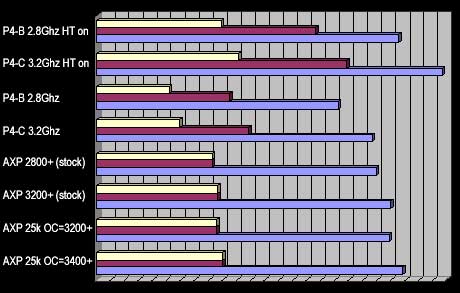
The above results were generated by SiSoft Sandra v2004.10.9.89. At 2300Mhz, my Athlon XP managed an ALU score of 8720 MIPS, and an FPU score of 3591 MFLOPS. That top mark that it’s beating is an Intel P4-B 2.8Ghz CPU with HyperThreading turned on. The FPU scores are the Yellow and Red bars. The yellow is the closest to an apples-to-apples comparison as it leaves out iSSE2 which is only available on the P4. The scale on the graph is from 0 to 100,000.

Modding the HSF

I had originally intended to complete my HSF duct mod before the last LAN party. Unfortunately, I got stiffed by hardwarecooling.com. Over the weekend I reordered the same parts from another vendor, casecooler.com. (got the parts 2 days later.. now that’s service!) With the parts in-hand to complete my HSF ducting mod; I tore open the packaging, unable to resist the urge to push my CPU a little harder… 🙂

Fans & Ducts
I tend to be somewhat of a conservative overclocker. I’m not all about coming up with exotic means of cooling down my hardware so I can push it over the red line. I prefer to make optimum use of conventional (and cheap) methods that still let me push my hardware towards that red line, but staying far enough back to avoid thermal death.
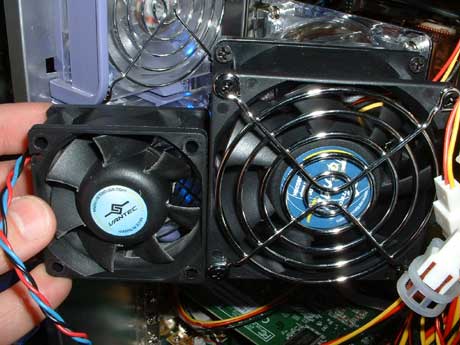
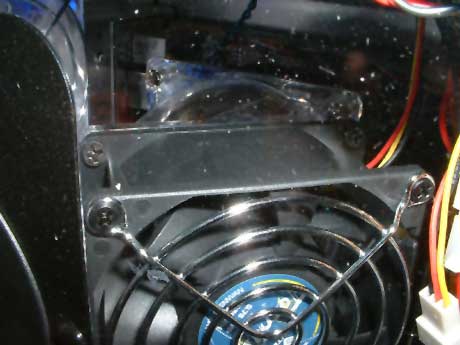
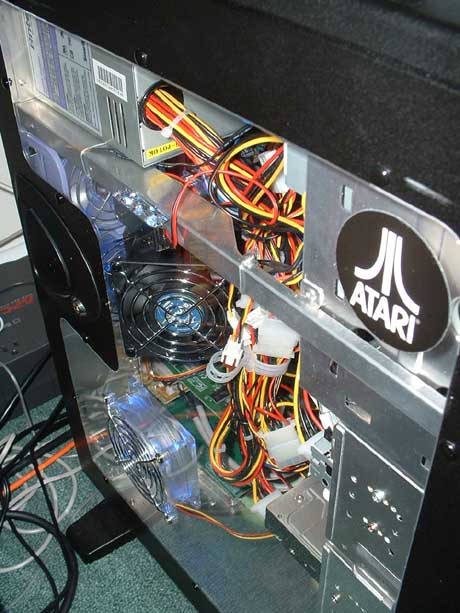
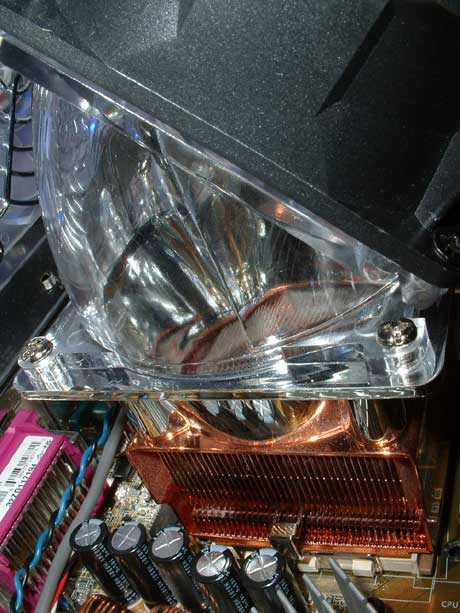
Here are some pics of the completed HSF duct mod. If you’re interested in the specifics, a more detailed article is available. This mod is currently perfoming at or below 40°C at the fan’s lowest speed. (AXP 2500+, FSB=400Mhz, CPU=2.21Ghz, PR=3200+)

Duct mod up close Stock 60mm vs. 80mm Vantec Tornado Duct-mod installed Lights-out Case, post-mod